
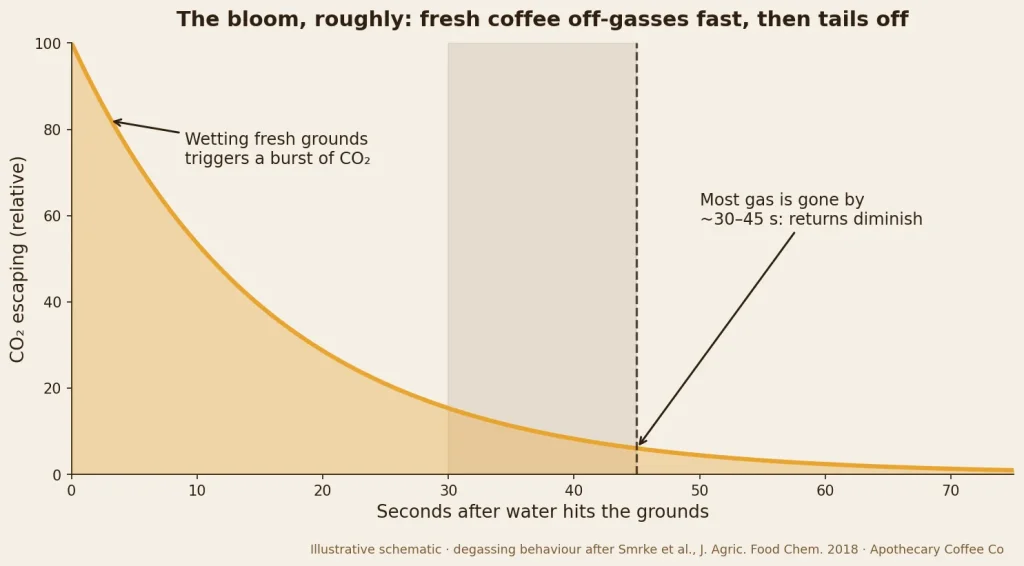
TL;DR: The bloom is real chemistry: wetting fresh grounds releases a burst of trapped carbon dioxide, and most of it is gone within about 30–45 seconds. Whether the bloom noticeably improves your cup is more contested. The degassing science is solid; the taste and extraction gains from how you bloom (leave it, swirl it, or stir it) come mostly from small single-variable tests by coffee creators, not large blind studies. Here is what the current evidence actually says.
What is being tested, and why it is divisive
“Blooming” means adding a small amount of water to fresh grounds (commonly a 2:1 to 3:1 water-to-coffee ratio), waiting, then continuing the brew. For years it was treated as non-negotiable for pour-over. Lately that consensus has cracked. A September 2025 Perfect Daily Grind round-up notes a growing number of Brewers Cup competitors dropping the dedicated bloom in favour of several small pours, while others insist on agitating it. So there are really three questions in play: does the bloom help, how long should it run, and should you disturb it?
The mechanism: it is a degassing step
Roasting loads coffee with carbon dioxide, trapped in the beans’ porous structure and released slowly during storage, then abruptly on grinding and wetting. That release is what makes fresh grounds puff and foam. The best characterisation of the kinetics is Smrke and colleagues’ time-resolved gravimetric work in the Journal of Agricultural and Food Chemistry (2018), which tracked how CO₂ leaves roasted and ground coffee over time. The practical worry is that CO₂ forms gas pockets that repel water, so brewing before it clears can give patchy, uneven saturation.
Two terms worth defining, since the tests below use them. Extraction yield (EY) is the percentage of the coffee’s mass that ends up dissolved in your cup; specialty brewing tends to aim for roughly 18–22%. TDS (total dissolved solids) is how concentrated the resulting drink is, in percent. More even saturation should, in theory, lift EY and reduce the harsh-and-sour unevenness of a channelled brew.
What the tests actually found
- Timing has diminishing returns. James Hoffmann’s widely followed pour-over guidance is to bloom for about 30–45 seconds; past roughly 45 seconds there is little further benefit, because most of the fast CO₂ release is already done.
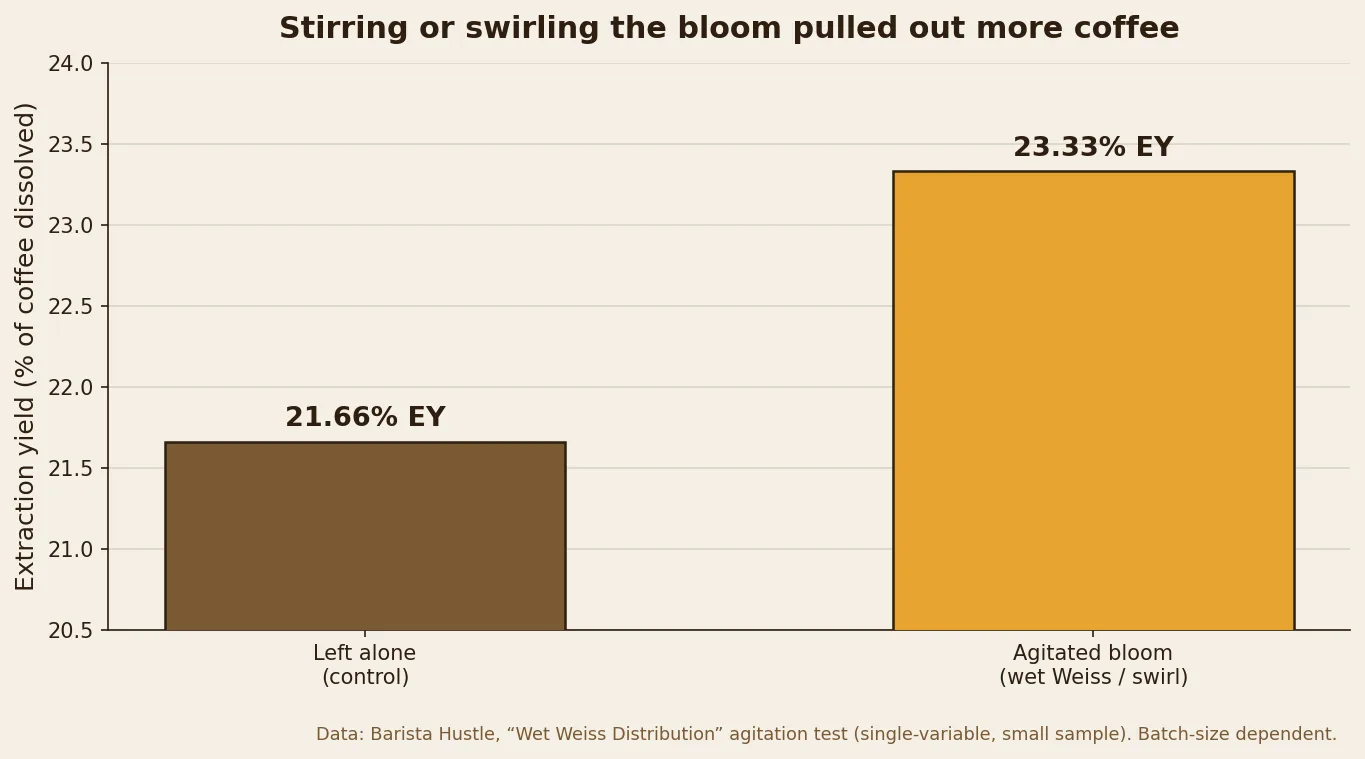
- Agitating the bloom raised extraction. In Barista Hustle’s tests, gently disturbing the bloom (a “wet Weiss” distribution / swirl) drove trapped gas out faster and lifted extraction yield to about 23.3%, versus about 21.7% for an untouched control.
- Stirring may beat swirling, but not at small doses. Their follow-up, “Stirring Strikes Back,” found stirring the bloom expelled more gas than swirling, with TDS climbing once stirring stopped, yet the effect shrank with small batches (around 15 g), where there simply is not much bed to work with.
- Skipping the bloom is now a real option. Competitors using continuous small pours are, in effect, blooming and brewing at once; the dedicated pause is not the only way to manage degassing.
How confident should we be?
Split it in two. The degassing side is well founded: peer-reviewed work confirms fresh coffee off-gasses CO₂ rapidly on wetting and that this tapers quickly. The brewing payoff side is softer. The extraction figures above come from careful but small, largely single-variable tests by educators and creators, typically not blinded and not replicated across many labs. They point consistently in the same direction, which is encouraging, but a 1–2 percentage-point EY shift is the kind of result that can move with grinder, water, and pour technique. Treat it as “good working evidence,” not settled fact.
The limits: when the bloom matters less
- Bean freshness. The bloom is a freshness phenomenon. Coffee that is several weeks off-roast has already shed most of its CO₂, so there is less to degas and the step does less. (This is the same clock we wrote about in how to actually store your beans.)
- Brew method. Most of this evidence is pour-over. In full-immersion methods the grounds sit in water the whole time, so a separate bloom does less distinct work.
- Grind and dose. Fines, agitation and small batches all shift the result; over-stirring fine grounds can clog flow, so more agitation is not automatically better.
The honest read: bloom your fresh coffee for around 30–45 seconds, and if you want a little more from a pour-over, a gentle swirl or stir is worth trying, though the taste upside is modest and depends on your kit. If you want to feel those extraction differences on your own palate, our plain-English V60 guide and our notes on reading tasting notes are a good next stop.
Sources
- Smrke, S. et al. “Time-Resolved Gravimetric Method To Assess Degassing of Roasted Coffee.” Journal of Agricultural and Food Chemistry, 66 (2018): 5293–5300. DOI 10.1021/acs.jafc.7b03310.
- Barista Hustle, “Wet Weiss Distribution” and “Stirring Strikes Back” (bloom agitation and TDS tests).
- Perfect Daily Grind, “Swirl, stir, or leave the bloom” (Sept 2025).
- James Hoffmann, “Ultimate V60 Technique” and related bloom guidance (YouTube).
Ready to taste the difference?
Fresh roasted by Apothecary in Blouberg, shipped to your door.
Browse our coffees →