
A guy came past the hatch last year to tell me about his new espresso machine… It really was a lovely piece of machinery. Dual boiler, PID, the lot, cost him more than my first car did (in case you’re interested – it was a used 2004 Mazda Midge and I didn’t pay a cent for it – my folks did) . And anyway, right at the end of the conversation he mentioned he grinds his beans in one of those little blade choppers, the kind you use for spices. I didn’t have the heart to say anything right then, mid-excitement, but he’d basically bolted a Ferrari engine onto a PnP (PEP?) shopping trolley.
Anyway, the one bit of gear advice I’d give anyone is that the grinder matters more than the machine. Nearly always, anyway. More than the machine, more than the fancy gooseneck kettle, and if your beans are already decent, probably more than the beans. It’s probably the most boring thing you’ll buy, but it ends up doing most of the work.
I know that’s not what anyone wants to hear. Everyone wants to talk about the machine, and I get it, it’s the shiny thing on the counter. But there’s an actual reason I keep going on about it.

What the grinder is doing to your beans
A grinder makes the beans smaller. That’s the job. What matters is how evenly it does it. When you brew, water pulls flavour out of the grounds, and small pieces give theirs up faster than big ones do. So what you’re after is everything roughly the same size, so it all extracts at roughly the same rate and finishes at roughly the same time.
That’s where cheap grinding falls to bits. A blade grinder (the spinning-propeller type, same idea as a spice or nut chopper) doesn’t grind to a size at all. It just smashes whatever’s in the chamber into whatever it happens to make, some dust, some gravel, all jumbled in together. The dust (the “fines”, if you want the proper word) over-extracts and turns bitter. The gravel (the “boulders”) under-extracts and comes out sour and thin. Then both land in the same cup at the same moment and you drink them at once, and you get this muddy, bitter-and-sour thing that no amount of fiddling with your brew will save, because the damage was done the second you hit the button.
A burr grinder works the other way around. Two burrs, metal discs or cones with teeth, sit a set distance apart, and the beans get crushed down until they’re small enough to drop through the gap. Whatever gap you set is more or less the size you get. It’s not flawless, nothing is, you’ll still get a spread of sizes, but it’s miles better than the blade lottery. That one swap, blade to burr, is the biggest single jump most people can make in their home coffee, and it costs a fraction of the machine they’re agonising over.

Why the machine gets all the credit
You see it all the time. Fifteen grand on the machine, a couple hundred on the grinder, and then they can’t work out why the coffee’s a bit… fine. Not bad, it’s just never quite what they were hoping for. I’ve been that person myself, more or less. For years I treated grinding as the dull step between beans and coffee, and at home I’d cheerfully chuck some grounds into a camping-style coffee maker and hope for the best (there’s a whole confession about that in my V60 post). And the whole time, the grinder was the thing actually deciding how it tasted, and I wasn’t giving it a second thought.
It shows up hardest with espresso, where everything is finicky and a hair of a change in grind size will swing a shot from sour trickle to bitter gush. When I was learning to pull a drinkable shot at home, which took a while and a fair amount of swearing (the full humbling is in the home espresso post if you’re in the mood), the dial I kept coming back to was the grinder’s, not the machine’s. I say this so often it’s become a bit of a tic: it’s almost always the grind. Nine times out of ten, when a shot comes out wrong, that’s where the problem is.
And it isn’t only an espresso thing. Pour-over, French press, AeroPress, the moka pot, they all lean on an even grind too, they’re just far more forgiving about it than espresso is. A moka pot or a French press with a good even coarse grind comes out clean and sweet. The same brew with a dusty blade grind gives you the silty, over-bitter mud that put half the country off French press for life. If you want the properly nerdy version of why uneven grinds wreck extraction, I went down that hole in a separate piece on grinding espresso finer, and there’s real published research sitting behind it, not just baristas talking.
So what should you buy?
Right, the useful bit. I’m not going to pretend there’s one perfect grinder, because it depends what you brew and what you’ve got to spend, and the hunt for the “best” grinder is a rabbit hole people climb into and never quite come back out of. (James Hoffmann has a whole beginner’s guide to grinders on YouTube that’s worth a watch, and also a very effective way to lose an afternoon.) But a few pointers, for whatever they’re worth.
If you’re mostly doing filter, pour-over or French press at home, a decent burr grinder is the move, and you don’t need to spend espresso money to get there. The one most people point you at first is the Baratza Encore, and I say that having actually used one. It’s slow and it’s a bit plasticky, but it grinds evenly and consistently for filter and it’ll happily outlast three of the machines people pair it with. (Full disclosure: I’ve got a barely-used one for sale second-hand as I write this, so feel free to take that with a pinch of salt. I’d tell you the same if I didn’t.)
If you’re on a tight budget and you’re not chasing espresso, a good hand grinder is about the best value in coffee, full stop. A decent manual will out-grind a cheap electric for filter, for a fraction of the price, at the cost of your arm and about a minute of your morning. I’m not too proud to grind by hand, and you shouldn’t be either.
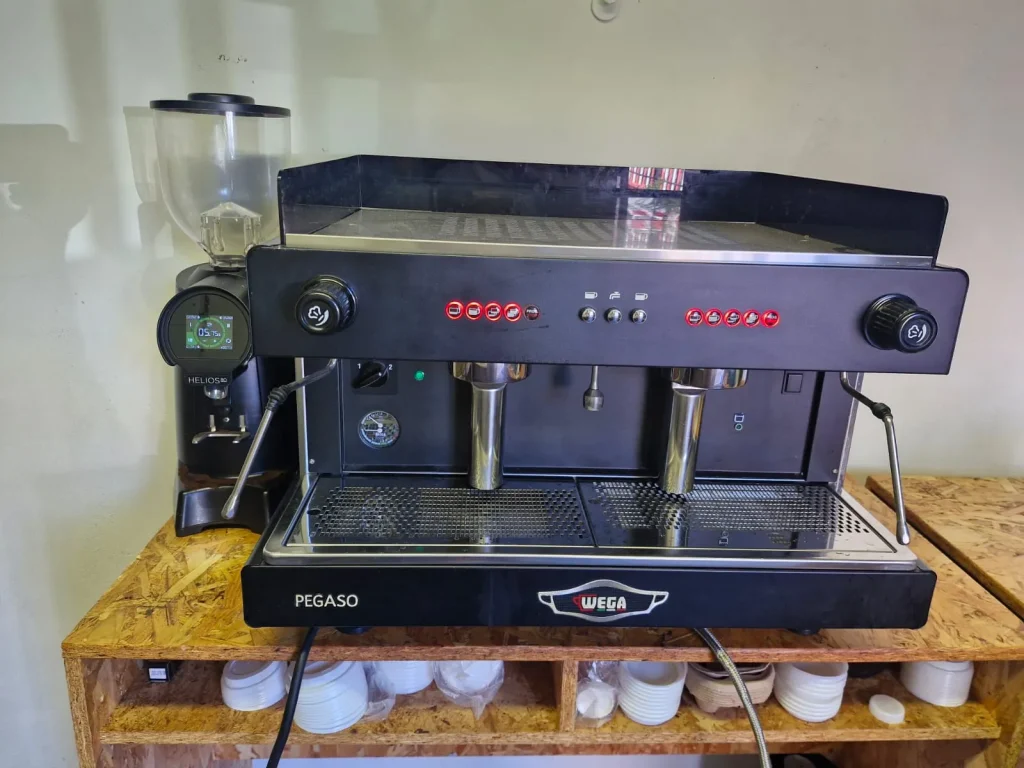
Espresso is where the wallet takes a proper hit, because espresso wants a finer, more consistent grind held to much tighter tolerances, and that precision costs real money. A good espresso grinder can cost as much as the machine, or more, and that’s the right way round rather than a mistake. The grinder in the photo up top, back on our old Apothecary cafe counter at Laude Classic Cars, next to our Wega, is a Eureka Helios 80, a serious on-demand commercial grinder, and it does far more for the coffee than most people would credit “just a grinder” with. I’ve run a few commercial machines like it over the years, and I’ve got a couple up for sale second-hand right now (that Helios and a Sigma), all of which I’ve actually used and written up honestly, cosmetic scratches and all. Overkill for a kitchen, obviously. But if you’re kitting out a little cafe or a coffee trailer, the same rule holds, just with a bigger number attached: don’t skimp on the grinder.
So if you’ve made it this far and you’re eyeing a new machine: sort the grinder first. If you’ve already got the machine and a rubbish grinder, upgrading the grinder will probably do more for your mornings than a whole new machine would. And if you’re just starting out with a cheap setup and a bag of good beans, don’t feel bad about it, most of us started right about there, and the gear catches up eventually.
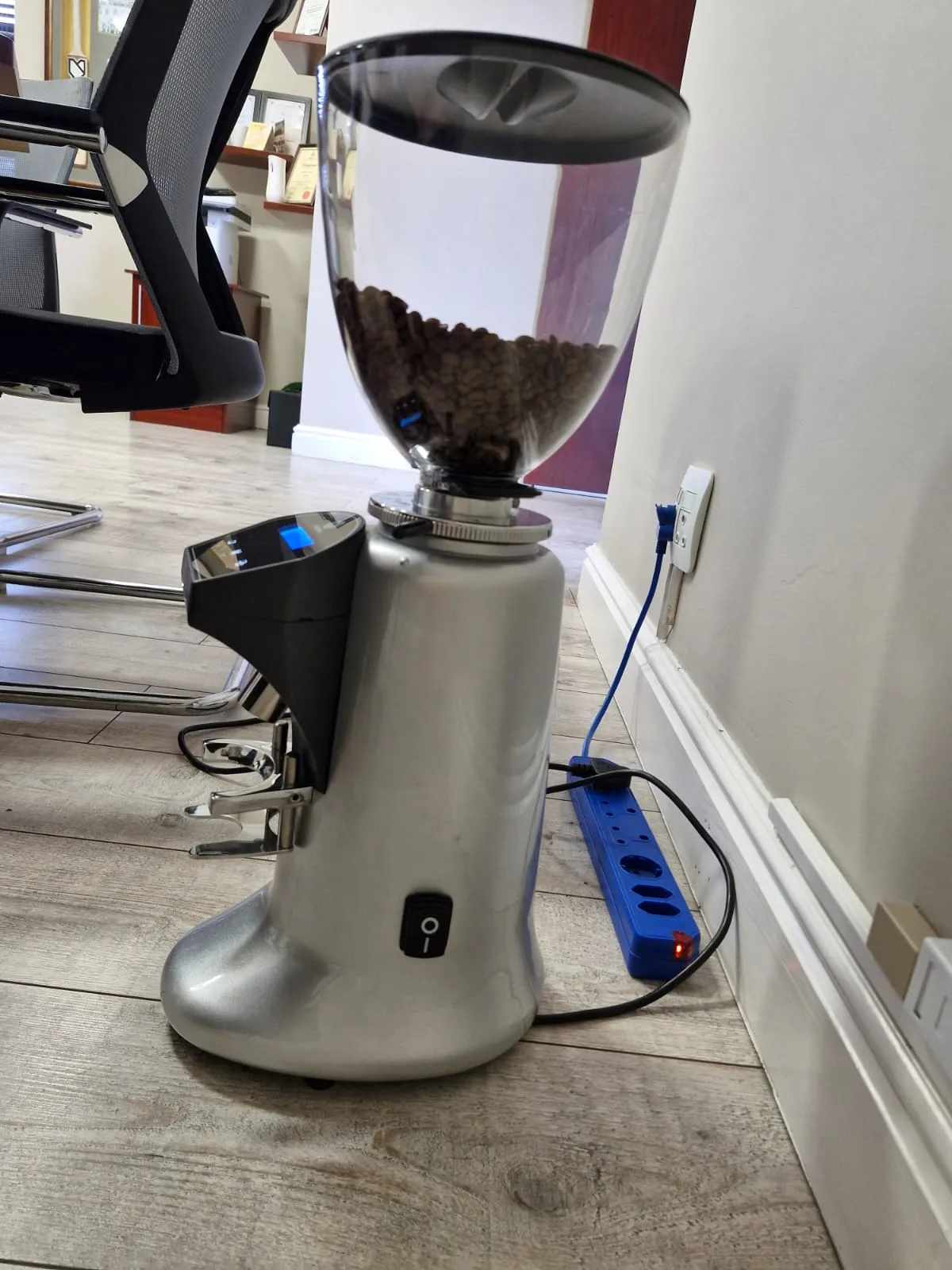
Because honestly, fiddling with the dial on a cheap grinder taught me more than any expensive bit of kit has since. I learned that one sat on an office floor next to a stack of office chairs, grinder plugged into the wall, wondering what on earth I was doing with my life. Best classroom I’ve had.
If reading about grinders has you wanting something worth grinding, our single-origin coffees and blends are roasted to order in Blouberg, and we post the odd bean-to-cup thing on Instagram at @apothecary_coffee_co. Grind them fresh, ideally right before you brew (that’s a whole other rant, and yes, I’ve written it).